
Journal / Polynucleotides in skincare: the complete ingredient guide
Polynucleotides in skincare: the complete ingredient guide
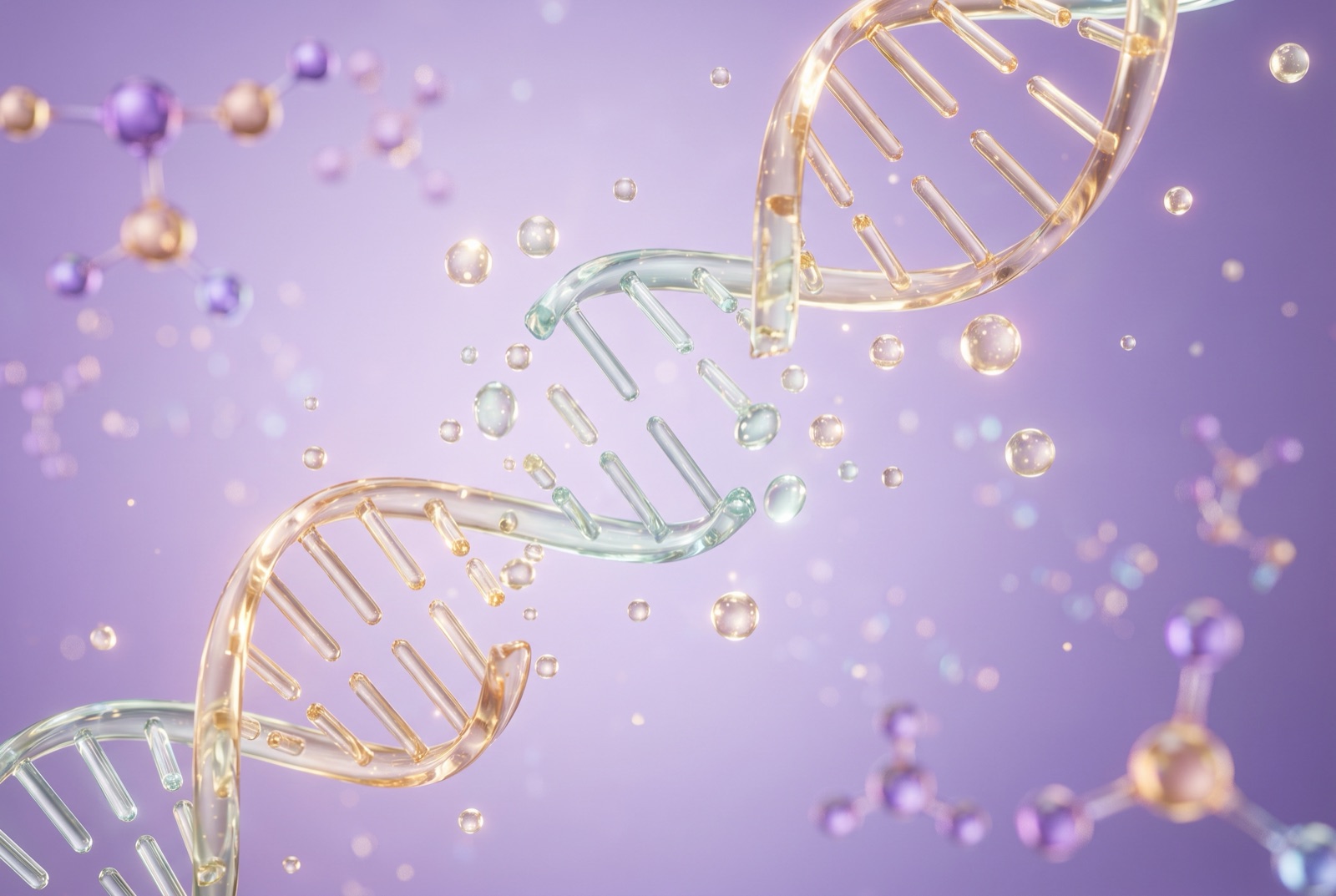
Polynucleotides went from a niche regenerative-medicine ingredient to one of the most requested treatments in aesthetic clinics in a few short years. If you’ve read our skin boosters overview, this is the deep dive on the molecule itself: what it is, where it comes from, and why the delivery route decides almost everything.
What polynucleotides are
Polynucleotides (PN) are long chains of nucleotides — the same subunits that make up DNA. In aesthetic and regenerative medicine, they’re used as a purified, highly processed biological material rather than as genetic information: the chains are fragmented to a controlled length, purified to pharmaceutical standards, and sterilized.
You’ll see a closely related acronym, PDRN (polydeoxyribonucleotide). The two terms are often used loosely and sometimes interchangeably in marketing. In practice PDRN generally refers to shorter, more precisely defined fragments studied in wound care, while PN describes longer chains used for their gel-like, tissue-supporting properties. Both come from the same family of raw material.
Why salmon?
Almost every PN product on the market is derived from salmon or trout milt. The reason is practical rather than poetic: fish-derived DNA is highly compatible with human tissue, has a long track record in medical use, and comes from a source with low risk of transmitting human pathogens. Manufacturers purify it to remove proteins and other cellular material — the purity level is one of the things that separates a professional-grade product from a cheap one.
How PN is used
In clinics, PN is injected in small amounts across an area — cheeks, under-eyes, neck, décolletage — rather than placed in a single deposit like filler. Practitioners choose it when the goal is tissue quality: skin that looks thin, dull, crepey, or that’s recovering from damage.
The material is also physically interesting: PN forms a soft gel in solution, so it provides a small amount of hydration and cushioning immediately, while its tissue-conditioning role builds over a course of sessions.
Typical protocols run 3–4 sessions, two to four weeks apart, with maintenance a couple of times a year. Downtime is generally limited to injection marks and occasional small bumps that settle within a day or two.
The delivery-route problem
This is the part worth internalizing: a polynucleotide cream is not a polynucleotide treatment.
PN molecules are large. Applied topically, they don’t cross the stratum corneum in any meaningful quantity — they sit on the surface, where they can act as a decent humectant and film-former, but not as the tissue-conditioning agent described in the clinical literature. Products marketed as “salmon DNA serum” are not doing what an injected PN course does, whatever the packaging implies.
There is a middle ground: PN applied immediately after microneedling, when channels in the skin are temporarily open. That’s a professional protocol, not a bathroom-cabinet routine.
Where RICHESSE fits
The RICHESSE™ line is built around this category — PN 2.5 as the high-concentration workhorse, éYes for the eye area, and Aqua Prime combining PN with hyaluronic acid for hydration-led protocols. All are professional products: they’re administered by trained practitioners, and we sell them to verified professional buyers.
Browse the full range in skin boosters, or read our companion guide on exosomes — the other regenerative ingredient reshaping treatment plans.
FAQ
Are polynucleotides and PDRN the same thing?
They’re closely related and often used interchangeably in marketing. Both derive from purified fish DNA; PDRN usually denotes shorter, more tightly specified fragments, while PN refers to longer chains. Check the product’s own documentation rather than the category label.
Do polynucleotide creams work?
Not the way injectable PN does — the molecule is too large to penetrate intact skin meaningfully. A PN-containing cream may still be a pleasant hydrator, but it isn’t a substitute for a clinical course.
Is there a fish-allergy risk?
Purified PN products are processed to remove proteins, which are what trigger fish allergies. Reputable manufacturers state this explicitly. Still, disclose any fish allergy to your practitioner — that’s exactly the kind of thing a consultation exists for.
How does PN compare to microneedling or lasers?
They’re complements, not competitors. Energy and needling devices create a controlled injury to trigger renewal; PN supplies conditioning support to the tissue. Many treatment plans use them in sequence.
This article is for informational purposes only and is not medical advice. Always follow the guidance of your healthcare provider or licensed aesthetician.